
Blog Post

The Game Plan – Property Investment

  • by Aspect Buyer's Agency
  • 29 Mar, 2016
Property investment success is not dependent on your current income level or some sheer stroke of luck. It requires strategy. The post The Game Plan – Property Investment appeared first on Aspect Buyer's Agency.

Property investment success is not dependent on your current income level or  some sheer stroke of luck. It requires the right strategy, mindset and the knowledge that building a successful property portfolio is not a get rich quick scheme.  If you do property investment right, though, you can achieve financial freedom.
Let’s start with our investor profile. Here is a typical, young Australian couple. This may not be indicative of your personal situation, but it’s a good starting point to help you build your own game plan.

 
Own Home Value
$600,000
Debt
1 credit card of $5,000, paid monthly in full
2 car loans of $40,000 total, with monthly repayments of $820 @ 8.49% interest
Savings
$15,000 in savings and $200 saved weekly
Mortgage
$400,000 (average mortgage in NSW were at a record high of $544,000 in December 2015*)
Available Equity
$200,000
 

Here’s a quick overview of the 5-step process to take you from home owner to property investor extraordinaire.
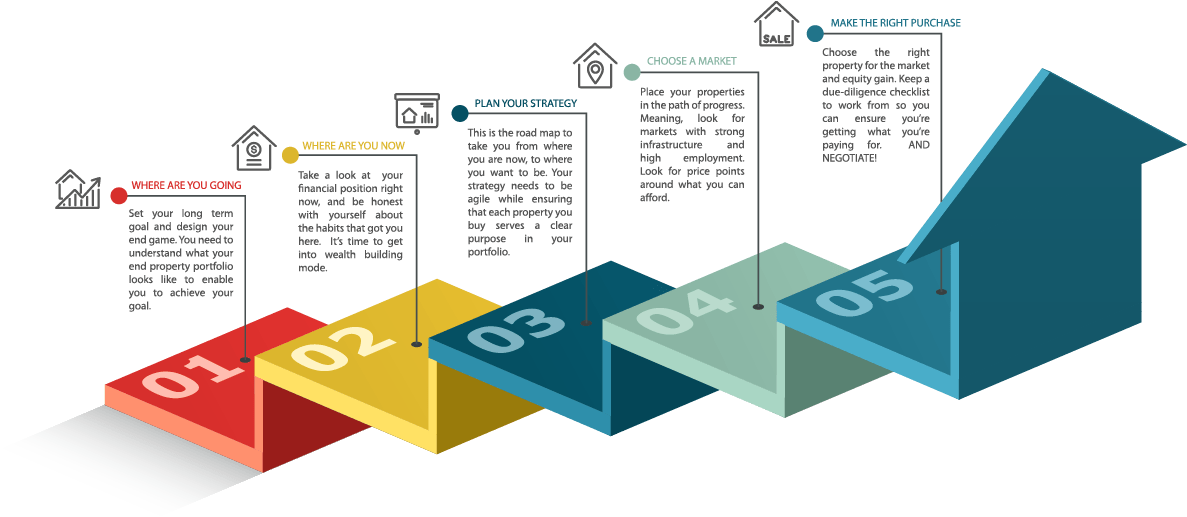
 
Click on the image to expand.

1.Where are you going?

The very first thing to do when embarking on property investment is to set a long term, specific goal. It’s cool to say that you own 50 properties, but the number of properties you own is irrelevant. Your goal should be focused on the net value of your assets and the net rental yield you receive.

 
This is an example of a long term, specific goal.
Once you’ve set your goal, this should be the driving force behind every property purchase you make. The income may fluctuate, and of course the time span will reduce, but the end-game remains the same.  Remember, it’s not about how many properties you need (or want).  It’s about the result that your properties will generate for your portfolio.

2. Where are you now?

It’s really important to have a clear understanding of where you’re positioned right now, so you can set the right path to reach your end goal. The fundamentals of the game plan apply to everyone, but your situation is unique to you. Remember, the aim here is to form the foundations of a solid property portfolio that will allow you to achieve your goal. You need to understand how you’re sitting financially, so be prepared to seek the answers from those who can readily access the right data and give you sound guidance – your mortgage broker, financial planner or accountant should be able to help here.  Let’s look at the factors that are critical in formulating your property investment strategy.

Your Assets
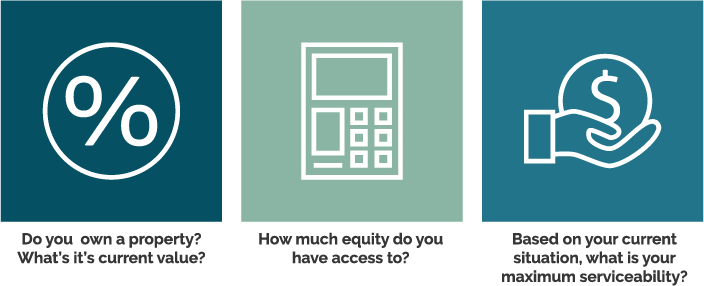
 

Your Financial Position.

Answer these questions to get a clear picture of your buying power.
  • What are the banks willing to lend you?
  • How much cash or equity will you need to satisfy your loan-to-value (LVR) ratio requirements on your investment property?
  • What is the maximum amount of property you can buy based on the amount of cash and equity you currently have, and the LVR you expect to invest at?

What’s your buying power?

Let’s do some quick sums.
Current value of your home (CVH) minus total mortgage (TM) equals total equity you have access to. (TE)
CVH – TM = TE
Based on our couple from our investor profile, this equates to:
$600,000 – $400,000 = $200,000
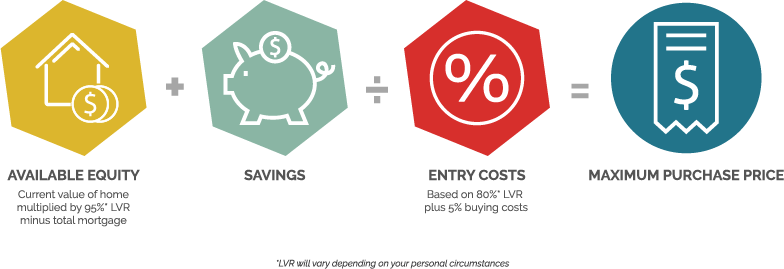
What we need to know, though, is the available equity (AE). So we need to factor in the 95% LVR over the family home.
$600,000 x 95% = $570,000 available equity
  • Our couple has $200,000 in equity
  • With an allowance of 95% LVR, releases $170,000 for further investment
  • They already have $15,000 in savings
So, taking their $15,000 in savings, in addition to their available equity of $170,000, our couple now has $185,000 to put towards building their portfolio. With $185,000 in cash and equity and an 80% LVR, we can work out easily the maximum amount we can spend on entering the world of property investment. With a 20% deposit plus an additional 5% in buying costs, we can put total entry at 25%.
Maximum purchase price: $185,000 divided by 25% = $740,000
 

Do you have sound wealth building habits?

Many people fall into the trap of believing that if they work harder, they can earn more, and in turn build wealth. Generally, though, the more you earn, the more you spend.  Good financial habits are really about how you manage your money.  Not the money you might one day have, but the money you have now.
If you’re serious about investing in your future, you need to get business-minded about your finances. Just as a business will have budgets and cash flows, so too should your household.  If you visit the app store and type in ‘budget planner’, you’ll get a whole list of free and simple apps that you can use on your smartphone.
Do you have a savings plan? If not, you need to get your hands on a copy of The Richest Man in Babylon . Written by George S. Caslon in 1926, this book is a classic in financial literature. It’s principles, written in parables and set in Ancient Babylon, are as relevant now as they ever were.  The very first lesson in this book is “Start thy purse to fattening”. Quite simply, pay yourself first. Before you pay your bills, buy groceries or put fuel in your car, set aside at least one tenth of your income in savings. Most of us tend to save what’s left over after all our expenses.  Flip this on its head, watch your savings account grow, and notice that you don’t even miss the money.
Making money is a mindset, an attitude, a willingness to do what it takes.
Get real with yourself about your financial habits. Read more on this here.
 

Do more with what you have.

“Gold in a purse is gratifying to own and satisfieth a miserly soul but earns nothing.”
Always consider ways to make your money work harder for you. Property investment is a long-term strategy, but consider opportunities in front of you right now.
  • Can you add value to your current property through a renovation?
  • If your income is limited, are there other opportunities to earn?
  • Can you afford to reduce debt more quickly?
 

Consider changes in circumstance.

Most of us tend to consider wealth building a compartment of our overall lives. It’s not. To be truly successful in building wealth, it needs to be integrated into every aspect of your life. So, it’s essential to consider how our lives evolve, and potential risks and stumbling blocks that may exist from a holistic perspective.
  • Don’t put all your eggs in one basket. What buffers do you have in place for your personal life?
  • What would happen if you stopped earning your current income tomorrow?
  • Is your job secure?
  • If you’re incapacitated, and can’t work, how do you get paid?
  • Do you have a dual income? Is this sustainable?
  • Is your family still growing?
  • If you’re single, what happens to your income when you start your own family?
  • Is your family healthy?
  • What happens if you decide to make a tree or sea change?
Every decision we make in life has risk associated to it, so don’t be dissuaded. Just take a realistic look at your life, and put measures in place to ensure if any major changes do occur, you won’t take toO much of a financial hit.

3. Plan your strategy.

There are three distinct phases in investing.

 

Acquisition Phase

This is the most critical stage. Get it right, you build a solid foundation to allow you to move into the consolidation phase and eventually into gaining the financial freedom you desire in the lifestyle/legacy phase.

Consolidation Phase

In this phase you consolidate to reduce debt, lower your LVR and increase cash flow. That’s exciting!

Lifestyle/Legacy Phase

Once you make it here, you’ve achieved financial freedom. While your enjoying the spoils of your riches, keep a sharp eye on maintaining the financial freedom you’ve worked so hard to create. Essentially, this is the management phase.
Each property you purchase has to serve a purpose in your portfolio to move you successfully through these phases, remembering that financial freedom is the ultimate outcome.
Now that you understand the different phases of property investment, let’s take a look at the three different tactics that contribute to your overall property investment strategy.

Long-term asset accumulation and capital growth

These properties are in stable markets that see steady and continual growth over time.

Self-Supporting

These pretty much pay for themselves, and generate enough cash flow to support your servicing.

Acceleration Strategy

This approach is really about buying properties that generate short-term profits, which enable you to accelerate the growth of your portfolio. Implementing the acceleration strategy creates larger deposits for future property purchases, and and can help quickly reduce the debt on other long-term properties.
Note  that the property type you consider contributes to your overall portfolio strategy. Don’t fall into the trap that many do, and take an accelerated approach to all property investments.
The purpose of your very first property really should be to create more equity for a deposit on your next property.

4. Choose your market.

This step is critical for first and second time investors. You don’t have to buy an investment property in the suburb or city that you live in. Unless the fundamentals of where you live actually align with your property investment strategy, it’s probably best to look at other locations. Capital city locations and major regional cities with strong infrastructure, industry and job security are good places to start.  Seek out markets that offer this at the right price point.

5. Make the right purchase.

Now that you know the type of property you’re looking at and why, you can embark on the exciting part of finding the right property that serves your overall purpose. This is where a due-diligence checklist is vital, so you can take a systematic approach to selecting the best fit-for-purpose property for your portfolio.
  • Research your potential markets and narrow it down to one or two options
  • What type of property in the chosen market is in great demand by the local residents (house, unit, etc)
  • Check if any maintenance work will be required in the short-term
There you have the five-step game plan to building a successful property portfolio. It can be pain-staking actually sitting down and running all these numbers, but it’s absolutely essential. This is your life, so be smart about it.
The second phase of your property investment strategy should be looking at future purchases and accumulating your next deposit. We’ll look at this in a future article. Now, if you haven’t done so already, create your investor profile and determine your long-term goal.  Use our investor profile as a guide.
Happy investing!
 
Disclaimer:
The information on this website is general in nature and does not take into account your personal circumstances, financial needs or objectives. Before acting on any information, you should consider the appropriateness of it and the relevant product having regard to your objectives, financial situation and needs. In particular, you should seek independent financial advice from your accountant or financial planner. 

 
 
by Matthew Ward 25 Feb, 2019

The Fallout from the Royal Commission, The Hayne Report and the Property Markets


There is no doubt – “the times they are a changin” in the finance world.

Towards the end of 2017, APRA brought in changes to the way people could access finance and the effects where certainly felt during 2018, the tighter controls on borrowing took the heat out of the Sydney and Melbourne property markets, the impact of which we are still watching unfold.

The Royal Commission into Banking (RCB) and subsequent recommendations in the Haynes Report, in short, reviewed the changes APRA and the banks had already made to access finance, and was generally happy with the measures that were put in place.

However, the big stick has been taken to the Mortgage Brokers, about how they are paid and their role in the finance process. There was issue taken by Mr Hayne, about the fact that banks cover the Mortgage Brokerage fee and pay them trailing commissions for the life of the loan.

Despite this payment process having been reviewed several times by independent bodies in recent years and found to be fair. The Hayne Report claims that this is the root of all evil and should outlawed. The major winners out of this will be the banks, and if all the recommendations are brought into play, the mortgage broking industry as we know it will be all but wiped out.


The Key Points to understand are as follows


· Will it be harder to borrow money?                      

No – It was already harder to borrow money due to the APRA changes in late 2017, So the Hayne report won’t be making it any harder than it already is.


·    Can you still use a Mortgage Broker?

Yes – for the time being. Depending on what recommendations are finally adopted will depend on the viability of the Mortgage Broking industry.                                                                          

·    Will the cost of borrowing increase?                                                                      

Possibly – Once again it will come down to recommendations that are finally adopted and how they are implemented. If Borrowers must pay for broking fees themselves, instead of the banks covering the cost, it will be bad for brokers, if banks also have to charge an upfront fee, it will mean borrowers will find it more expensive and harder to change loans or banks.


·   Will this impact on the Property Markets?

Yes and No – Yes in the way that we have already seen, with over priced property markets like Sydney and Melbourne experiencing a fall in Median house prices, although it should be noted that not all Sydney and Melbourne Suburbs are falling in value. Some are still increasing. The biggest impacted will be the restriction on finance causing a lack of demand, which creates a price decrease or market slow down.


The No part of the answer is that markets that didn’t that massive price rise or started at a low value level, won’t be impacted as much and will probably continue to steadily rise. With all this in mind 2019 will be the year of Return on Investment (ROI).

 With capital gain expected to take a back seat for a while, the yield/ROI is already starting to be a major consideration.

 If you want to know more about how to determine the ROI or any other property investment matters, please feel free to get in touch.

by Matthew Ward 04 Dec, 2018

Whilst December is always a mixture of winding down or going flat out to get jobs done before Christmas,

It is currently a buyers’ market and whilst the media may have been talking down the capital city markets the regional markets have been soldiering on, with some significant capital growth across many of the major Regional Centers over the past 12 months. A few examples are as follows;

Orange – 11.0%

Wagga Wagga – 5.2%

Tamworth – 5.4%

Dubbo – 3.8%

Nowra – 7.0%

Whilst the markets maybe cooling, they are still experiencing capital gain.

As the markets cool and many buyers get busy focusing on other things at this time of year, it creates an opportunity for focused buyers to take advantage of this market lull. Vendors tend to be more focused for those people that are still hunting around and are usually willing to consider lower offers.

Vendors have plans too that they need to get on with and the sale of the property may be the critical step they need to move on. If you have been sitting on your hands this year with a “wait and see” attitude, in the above-mentioned markets for example it has already cost you somewhere between $16,000 - $44,000 on the median house price on capital gain alone.

The Royal Commission into Misconduct in the Banking, Superannuation and Financial Services Industry concludes shortly, once the recommendations have been handed down, the banking sector will know where they stand, and finance availability should start to open up, after all, Banks are in the business of lending money.

As finance becomes more accessible, sometime in the New Year the property market will see the impact of pent up demand, of the many investors who were shut out of the market or opted for the “Wait and See” approach for the later part of the 2018.

If you are in the position to buy property for either investment or owner occupation, NOW is the time to make that happen and fill your Christmas Stocking with Bricks and Mortar.

For all of you who have supported Aspect Buyers Agency through out 2018, we thank you, it’s been a great year and we very thankful for everyone’s continuing support.

We are closing for the Christmas Break  21st December, and will reopen 2nd January 2019, so if you have any enquires regarding property purchasing or any general property queries we are always happy to help.

On behalf of the team and myself, I wish you all a very Happy Christmas and a Safe New Year, and I look forward to working with you in 2019.

Happy Investing – Matthew Ward.

by Matthew Ward 08 Nov, 2018


There has been a lot of noise in the media of late about the increasing popularity of living and investing in larger regional cities, and one of those cities is Orange NSW. It has been touted as a real “Hot Spot” for property investors and owner occupiers a like, in addition to a great food and entertainment destination.

We decided to have look at what is making Orange “So Hot Right Now!”


From an economic stand point, there is an enormous amount of investment coming into Orange across several sectors, coupled with a proactive Local Government, which is helping pitch Orange as the financial, medical and R &D centre of Regional NSW.

Some of the main headline investments for 2018/2019 are as follows:

· Regional Development Fund - $4 Billion Government Loan Fund, Head quartered in Orange with 32 new jobs

· SparkLabs Cultiv8 – Collaborative Ag Tech R & D Hub, combining government and private funding to enhance and accelerate agri tech solutions and companies, attracting domestic international companies into the region

·  Department of Primary Industries relocation - $30 million development with room for 900 staff

·  Bloomfield Medical Centre - $50 million development, incorporating a new 82 Room motel with function centre, Allied Health Clinic, and retail space, creating around 500 new jobs

·  New Quest Apartments – $10.5 million 77 Room motel, conference and retail space development and associated job creation

Whilst these are the main investments there are a significant number of smaller investments, and other yet to be announced larger investment schemes for the Orange region.


Orange is positioning itself as the Medical and Education Hub , with tertiary education provided by the Orange Tafe, and Charles Sturt University, contributing to approx. $28 million annually to the Orange economy and supplying over 400 jobs. With long term success of the University the main goal of CSU, further investment in the Orange Campus could be expected.

Kinross Wolaroi   Private School  provides the opportunity for access to a similar or better caliber of education and school facilities as some of the top Sydney private schools  and is often a deciding factor for tree changing families to settle in Orange.

Significant investment from the NSW Health Department in the development of the New Orange Base Hospital in 2012, has set the foundation for a rapid increase and concentration of specialist doctors and health facilities to be based either at the new hospital or within Orange.

The Health and Social services industry currently provide approx. 21% of the employment base in according to the 2016 ABS data.

Another is the regions mining sector which adds approx. $2.6bill in export revenue annually and provides over 3,500 jobs across the regions 3 main sites.

This broad multi facet economy is offering the career-oriented jobs that attracts, those with specialist skills and higher incomes.

Employment opportunities is only one side of the equations, what turns short term positions into life long careers is the ability to attract and retain the right kind of people into those positions.

This is where Orange has another strong game.

The Lifestyle factor, coupled with the strength and dominance of the of the local food and wine industry and associated business, has boosted the quality and quantity of the what the town has to offer.

With many social events and tourism-based activities, the great sporting, recreation and leisure facilities. The ability to engage and entertain the residents is key to retaining people in the city.

The introduction of direct flights to Brisbane and Melbourne, in addition to the existing Sydney flights, means that business and holiday options are suddenly more accessible and affordable, opening further opportunities, and adding to the lifestyle and tourism benefits.

Infrastructure improvement has also taken place with the multi million upgraded facilities of Orange airport to cater for larger planes and $250 million upgrade to the Great Western Highway between Katoomba and Lithgow.

Its this combination of lifestyle, Jobs, facilities, infrastructure and education that are combing to create a very desirable destination for the weekend or for a more permanent stay. The rising number of tree changers who are either retiring or moving their families out of ever increasing congested and over priced capital city is rising every year, with population predictions expected to hit 60,000 in the not too distant future.


So how does all this impact on the property market?

Average House Prices Increased approx. 11% in past 12 months

Current V acancy Rate 1.78% (anything under 2.0% – 2.5%is desirable)

Gross Rents increased approx. 5.88% in past 12 months

(Source; realestateinvestar.com.au)

Part of the reason behind this is investors looking for more affordable property, but there is a significant sector of tree changers and inter regional movement as Orange has become a destination of choice for many retiring farmers or regional based workers looking to take advantage of the cities offerings.

To Find out more about buying in Orange please contact Aspect Buyers Agency - Your Regional Property Experts.


More posts
Share by: